Archive for category OSS adoption
The relationship between Open Core, dual licensing and contributions
Posted by cdaffara in OSS adoption, OSS business models on July 21st, 2010
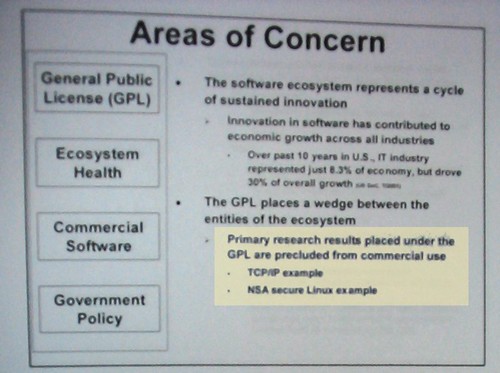
Open Core continues to receive substantial bashing, both after the announcement of the new SugarCRM 6 and after the recent OpenStack intitiative. Sugar introduces a new interface that is not available in the open source edition (they are not the first in this: actually, Open-Xchange did it before them, making the javascript code for the new AJAX interface not usable for commercial activities), but despite this they claim “We are an open source company” In the OpenStack announcement, The Register reports that it was not possible for NASA to introduce the changes to Eucalyptus because that would have undermined the capability of the company to make users pay for the enterprise edition. I already wrote in the past that Open Core is not evil per se, but that it does introduce difficulties in encouraging external participation; both because there is a very thin line in feature selection between the community and enterprise edition, and because open core naturally hampers participation. I had some readers asking me why, and I will respond with a subset of my LinuxTag slides:

Open core is usually built by a set of internal open source components held together by a dual-licensed wrapper, plus proprietary modules on the outside. One of the best examples of this is Zimbra (an excellent product on its own) but MySQL in recent editions can be included in the same group. As discussed in previous posts, dual licensing hampers contributions because it requires an explicit agreement on ceding rights to the company that employs it, in order to be able to relicense it for the proprietary edition. This means that Open Core companies, in itself, will have an easier time in monetizing their software, but will receive much less contributions in exchange. As I wrote before, it is simply not possible to get something like Linux or Apache with Open Core.
Again: open core is not bad per se (but I would have been more cautious in calling Sugar “an open source company”, for whatever definition you have of that). But it is a tradeoff: monetization versus contributions. And, my bets are on contributions, as OpenStack demonstrates – you need leverage and external resources to go beyond what a single company can do.
An on-vacation post on Open core
Posted by cdaffara in OSS adoption, OSS business models on July 6th, 2010
[Note: since I am writing this from a sunny beach, with a cell phone, I will not be able to add more than a few links to external pages. Will add the rest of them at my return, after the 12th of July]
It seems that Open Core continues to be the source of significant debate; I wrote quite a few posts in the past, and Open Core was one of our researched business models (for more details, see my LinuxTag presentation on business models). I would like to enter again the debate with a few short comments on my own:
- Companies using OC are not the devil, and should not be called names because of their choice of business model. Actually, there are no good and bad business models - only models that work, and those that do not. So, if open core works for a company, that’s a good thing.
- Open core models are somehow confusing for adopters. As a consultant for more than 100 companies and public administrations, actually explaining open core is one of my most common tasks. And the marketing message of companies is confusing: if you go to the Zimbra webpage (no offence against Zimbra, which is a company/product I love and use as example of good practice) you see the phrase “Zimbra – the leader in open source email and collaboration”, not “Zimbra – the leader in open source and proprietary email” (not that the phrase would win any context
) and the same for all the other open core companies. This is not, in my opinion, such a negative point if the website explains the difference between versions in a simple way, as for example both Zimbra and Alfresco do. - It is true that open core models tend to have a higher revenue than non-OC models. It is also true that OC does have an intrinsic limited number of contributions from outside (as we found in FLOSSMETRICS analysing a few hundreds packages), and as can be found in the mentioned LinuxTag presentation. So, you may have higher monetization ratio, but you basically forfeit external contributions. The CEO should decide what is more important – so the decision is not “ethical”, but practical and based on economics. You will never get the kind of participation that Linux, Apache and Eclipse do have in an Open Core model. If that is ok for you – that’s great.
- The fact that most VC are funding open core companies is just a data point. Lots of open source companies do well without VC funding.
- It is true that lots of people claims that “pure” open source models are not sustainable. Even my friend Erwin Tenhumberg (that is quite knowledgeable, expert and incredibly nice on its own) had a slide in this sense in his LinuxTag presentation; and you can find lots of comments like that in many publication (something like “the majority of OSS companies adopt the so called mixed model”, despite this being actually false, as we found in our survey of OSS companies). The point, like said before, is that the important thing is not that there is a superior model, but that for every company, every market there is an optimal model – it may be OC, it may be pure services, or lots of combinations of our 11 building blocks. The optimal model changes with time and market condition, and what is appropriate now may be wrong tomorrow.
- No open source model can achieve the kind of profit margins of proprietary companies. So, if you want to make your OSS company, remember this basic fact. If you want the kind of profit margins of Microsoft or Oracle, forget it.
So, to end this post, there are three critical points: whether the model is clear for the adopter (and this should be a given, and actually nowadays I would say that most companies are absolutely honest and clear on this), whether the software in its open source edition provides sufficient functionality to be useful to a wide range of adopters (and this is a fine line to walk, and requires constant adaptation) and whether the increased monetization compensates for the lack of external contributions, that can substantially increase the value of the code base (you are trading cash for code and engineering, in a sense).
Can we put this to rest? End the name calling, be friends, and call all of us family? Especially since right now, under the sun of Fuerteventura where I am writing this, it seems difficult to fight
[by the way: sorry for any misspelling. There is no spell checker here on this small screen...]
And now, for something totally different: EveryDesk!
Posted by cdaffara in OSS adoption, blog on June 21st, 2010
Now that most of our work for FLOSSMETRICS is ended, I had the opportunity to try and work on something different. As you know, I worked on bringing OSS to companies and public administration for nearly 15 years now, and I had the opportunity to work in many different projects with many different and incredible people. One of the common things that I discovered is that to increase adoption it is necessary to give every user a distinct advantage in using OSS, and to make the exploratory process easy and hassle-free.
So, we collected most of the work done in past projects, and developed a custom desktop, designed to be explorable without installation, fast and designed for real world use; EveryDesk is a reinterpretation of the Linux desktop, designed to be used in public administrations or as an enterprise desktop. EveryDesk is a real OS on a USB key, not a live CD; this way the system allows for extensive customization and adaptation to each Public Administration need It is the result of the open sourcing of part of our HealthDesk system, designed using the result of our past European projects COSPA (a large migration experiment for European Public Administrations), SPIRIT (open source health care), OpenTTT (OSS technology transfer) and CALIBRE (open source for industrial environments).
EveryDesk is a binary image designed for 4GB USB keys, easy to install with a single command both on Linux and Windows, simple to replicate and adapt. It does provide a simple and pleasing user interface, with several pre-installed applications and native support for Active Directory. EveryDesk supports roaming/nomadic work through a special mode that stores all user data on a remote SMB server (both Samba and Windows are supported). This way, the user’s USB key contains no personal data, and can be used in environments that manage sensitive data, like health care or law enforcement.
The files and images can be downloaded from the SourceForge project page.
EveryDesk integrates a simple and easy to use menu, derived from Novell usability research studies, providing one-click access to individual programs, documents, places; easy installation of new software or updates, thanks to the fully functional package manager.
EveryDesk includes support for Terminal Services, VNC, VmWare View and other remote access protocols. One peculiarity we are quite happy with is the idea of simplified VDI; basically, EveryDesk integrates the open source edition of VirtualBox, and allows for mounting the disk images remotely – so the disk storage is remote, and the execution is local. This way, VDI can be implemented by adding only storage (that is cheap and easy to manage) and avoiding all the virtualization infrastructure.

The seamless virtualization mode of VirtualBox allows for a quite good integration between Windows (especially Windows 7) and the local environment. Coupled with the fact that the desktop is small and runs in less than 100MB (with both Firefox and OpenOffice.org, it takes only 150MB) it makes for a good substitute of a traditional thin client, is manageable through CIM, and is commercially supported. Among the extensions developed, we have a complete ITIL compliant management infrastructure, and digitally-signed log storage for health care and law enforcement applications.
For more information: our health care home page, main site, on twitter, facebook, and of course here!
On open source competence centers
Posted by cdaffara in OSS adoption on April 26th, 2010
Just a few days ago, Glynn Moody posted a tweet with the message: “Italy to begin an open source competence centre”; a result of the recent EU project Qualipso, created with the purpose to identify barriers to OSS adoption, quality metrics and with the explicit target of creating a network of OSS competence centers, sharing the results of the research effort and disseminating it with the European community of companies and public administration. For this reason, the project created more than one competence center, and created a network (that you can find under this website) to cover not only Europe, but China, India and Japan as well. This is absolutely a great effort, and I am grateful to the Commission and the project participants for their work (hey, they even cited my work on business models!)
There is, however, an underlying attitude that I found puzzling – and partially troubling as well. The announcement mentioned the competence center of Italy, and was worded as there was no previous such effort in that country. If you go to the network website, you will find no mention of any other competence center there, even when you consider that the Commission already has a list of such centers (not much updated, though) and that on OSOR there is even an official group devoted to Italian OSS competence centers, among them two in Friuli (disclaimer: I am part of the technical board of CROSS, and work in the other), Tuscany, Trentino, Umbria, Emilia (as part of the PITER project), a national one and many others that I probably forgot. Then we have Austria, Belgium, Denmark, Estonia, Finland, Germany, Ireland, Malta, Netherlands, Nordic Countries and many others. What is incredible is that most of these centers… actually don’t link one with the other, and they hardly share information. The new Qualipso network of competence centers does not list any previous center, nor does it point to already prepared documentation – even by the Commission. The competence center network website does not link to OSOR as well, nor does it links to other projects – past or current.
I still believe that competence centers are important, and that they must focus on what can be done to simplify adoption – or to turn adoption into a commercially sustainable ecosystem, for example by facilitating the embracing of OSS packages by local software companies. In the past I tried to summarize this in the following set of potential activities:
- Creating software catalogs, using an integrated evaluation model (QSOS, Qualipso, FLOSSMETRICS-anything, as long as it is consistent)
- For selected projects, finds local support companies with competence in the identified solution
- Collect the needs of potential OSS users, using standardized forms (Technology Request/Technology Offer, TR/TO) to identify IT needs. Find the set of OSS projects that together satisfies the Technology Request; if there are still unsatisfied requirements, join together several interested users to ask (with a commercial offer) for a custom-made OSS extension or project
- Aggregate and restructure the information created by other actors, like IST, IDABC, individual national initiatives (OSOSS, KBST, COSS, …)
This models helps in overcoming several hurdles to OSS adoption:
- Correctly identify needs, and through analysis of already published TR can help in aggregating demand
- Helps in finding appropriate OSS solutions, even when solutions are created through combination of individual pieces
- Helps in finding actors that can provide commercial support or know-how
It does have several potential advantages over traditional mediation services:
- The center does NOT participate in the commercial exchange, and in this sense acts as a pure catalyst. This way it does not compete with existing OSS companies, but provides increased visibility and an additional dissemination channel
- It remains a simple and lean structure, reducing the management costs
- By reusing competences and information from many sources, it can become a significant learning center even for OSS companies (for example, in the field of business models for a specific OSS project)
- It is compatible with traditional IT incubators, and can reuse most of the same structures
Most of this idea revolves around the concept of sharing effort, and reusing knowledge already developed in other areas or countries. I find it strange that the most difficult idea among these competence centers is… sharing.
(update: corrected the network project name – Qualipso, not Qualoss. Thanks to Matteo for spotting it.)
Why COMmunity+COMpany is a winning COMbination
Posted by cdaffara in OSS adoption, OSS business models on October 16th, 2009
There is an interesting debate, partially moved by Matt Asay, with sound responses from Matthew Aslett, that centered on the reasons for (or not) moving part of the core IP asset of an open source company towards an externally controlled group, like a consortia. Matthew rightly indicates that this is probably the future direction of OSS (the “4.0″ of his graph), and I tried to address this with a few friends on twitter- but 140 chars are too few. So, I will use this space to provide a small overview of my belief: the current structure based on open core is a temporary step in a more appropriate commercialization structure, that for efficiency reason should be composed of a commuity-managed (or at least, transparently managed) consortia that manages the “core” of what now is the open source part of open core offerings, and a purely proprietary company that provides the monetization services, may those be proprietary add-ons, paid services and so on.
Why? Because the current structure is not the most efficient to enable participation from outside groups- if you look at the various open core offerings, the majority of the code is developed from in-house developers, while on community-managed consortia the code may be originated by a single company, but is taken up by more entities. The best example is Eclipse: as recently measured, 25% of the committers work for IBM, with individuals accounting for 22%, and a large number of companies like Oracle, Borland, Actuate and many others with percentages that go from 1 to 7% in a collective, non-IBM collaboration.
Having then a pure proprietary company that sells services or add-ons also removes any possibility of misunderstanding about what is offered to the customer, and thus will make the need of a “OSS checklist” unnecessary. Of course, this means that the direction of the project is no longer in the hand of a single company, and this may be a problem for investors- that may want to have some form of exclusivity or guarantee of maintaining the control. But my impression is that there is only the illusion of control, because if there is a large enough payoff, forks will make the point moot (exactly like it happened with MySQL); and by relieving control, the company gets back a much enlarged community of developers and potential adopters.
2020 FLOSS Roadmap, 2009 Version published
Posted by cdaffara in OSS adoption, blog on October 13th, 2009
Having contributed to the new edition of the 2020 FLOSS roadmap, I am happy to forward the announcement relative to the main updates and changes of the 2020 FLOSS roadmap document. I am especially fond of the “FOSS is like a Forest” analogy, that in my opinion captures well the hidden dynamics that is created when many different projects create an effective synergy, that may be difficult to perceive for those that are not within the same “forest”.
For its first edition, Open World Forum had launched an initiative of prospective unique in the world: the 2020 FLOSS Roadmap (see 2008 version). This Roadmap is a projection of the influences that will affect FLOSS until 2020, with descriptions of all FLOSS-related trends as anticipated by an international workgroup of 40 contributors over this period of time and highlights 7 predictions and 8 recommendations. 2009 edition of Open World Forum gave place to an update of this Roadmap reflecting the evolutions noted during the last months (see OWF keynote presentation). According to Jean-Pierre Laisné, coordinator of 2020 FLOSS Roadmap and Bull Open Source Strategy: “For the first edition of the 2020 FLOSS Roadmap, we had the ambition to bring to the debate a new lighting thanks to an introspective and prospective vision. This second edition demonstrates that not only this ambition is reached but that the 2020 FLOSS Roadmap is actually a guide describing the paths towards a knowledge economy and society based on intrinsic values of FLOSS.”
About 2009 version (full printable version available here)
So far, so good: Contributors to the 2020 FLOSS Roadmap estimate that their projections are still relevant. The technological trends envisioned – including the use of FLOSS for virtualization, micro-blogging and social networking – have been confirmed. Contributors consider that their predictions about Cloud Computing may have to be revised, due to accelerating adoption of the concepts by the market. The number of mature FLOSS projects addressing all technological and organizational aspects of Cloud Computing is confirming the importance of FLOSS in this area. Actually, the future of true Open Clouds will mainly depend on convergence towards a common definition of ‘openness’ and ‘open services’.
Open Cloud Tribune: Following the various discussions and controversies around the topic “FLOSS and Cloud Computing”, this opinion column aims to nourish the debates on this issue by freely publishing the various opinions and points of view. 2009’s article questions about the impact of Cloud Computing on employment in IT.
Contradictory evolutions: While significant progress was observed in line with 2020 FLOSS Roadmap, the 2009 Synthesis highlights contradictory evolutions: the penetration of FLOSS continues, but at political level there is still some blocking. In spite of recognition from ‘intellectuals’. the alliance between security and proprietary has been reinforced, and has delayed the evolution of lawful environments. In terms of public policies, progress is variable. Except in Brazil, United Kingdom and the Netherlands, who have made notable moves, no other major stimulus for FLOSS has appeared on the radar. The 2009 Synthesis is questioning why governments are still reluctant to adopt a more voluntary ‘FLOSS attitude’. Because FLOSS supports new concepts of ’society’ and supports the links between technology and solidarity, it should be taken into account in public policies.
Two new issues: Considering what has been published in 2008, two new issues have emerged, which will need to be explored in the coming months: proprietary hardware platforms, which may slow the development of FLOSS , and proprietary data, which may create critical lock-ins even when software is free.
The global economic crisis: While the global crisis may have had a negative impact on services based businesses and services vendors specializing in FLOSS, it has proved to be an opportunity for most FLOSS vendors, who have seen their business grow significantly in 2009. When it comes to Cloud-based businesses, the facts tend to show a massive migration of applications in the coming months. Impressive growth in terms of hosting is paving the way for these migrations.
Free software and financial system: this new theme of the 2020 FLOSS Roadmap makes its appearance in the version 2009 in order to take into account the role which FLOSS can hold in a system which currently is the target of many reflexions.
Sun/Oracle: The acquisition of Sun by Oracle is seen by contributors to the 2009 Synthesis as a major event, with the potential risk that it will significantly redefine the FLOSS landscape. But while the number of major IT players is decreasing, the number of small and medium-size companies focused around FLOSS is growing rapidly. This movement is structured around technology communities and business activities, with some of the business models involved being hybrid ones.
FLOSS is like forests: The 2009 Synthesis puts forward this analogy to make it easier to understand the complexity of FLOSS through the use of a simple and rich image. Like forests and their canopies – which play host to a rich bio-diversity and diverse ecosystems – FLOSS is diverse, with multiple layers and branches both in term of technology and creation of wealth. Like a forest, FLOSS provides vital oxygen to industry. Like forests, which have brought both health and wealth throughout human history, FLOSS plays an important role in the transformation of society. Having accepted this analogy, contributors to the Roadmap subsequently identified different kind of forests: ‘old-growth forests’ or ‘primary forests’, which are pure community-based FLOSS projects such as Linux; ‘cultivated forests’, which are the professional and business-oriented projects such as Jboss and MySQL; and ‘FLOSS tree nurseries’, which are communities such as Apache, OW2 and Eclipse. And finally the ‘IKEAs’ of FLOSS are companies such as Red Hat and Google.
Ego-altruism: The 2009 Synthesis insists on the need to encourage FLOSS users to contribute to FLOSS, not for altruistic reasons, but rather for egoistical ones. It literally recommends users to only help when it benefits themselves. Thanks to FLOSS, public sector bodies, NGOs, companies, citizens, etc. have full, free and fair access to technologies enabling them to communicate on a global level. To make sure that they will always have access to these powerful tools, they have to support and participate in the sustainability of FLOSS.
New Recommendation: To reinforce these ideas, the 2020 FLOSS Roadmap in its 2009 Synthesis added to the existing list of recommendations:
Acknowledge the intrinsic value of FLOSS infrastructure for essential applications as a public knowledge asset (or ‘as knowledge commons’), and consider new means to ensure its sustainable development
“Libre Software for Enterprises”: new issue of the European Journal for the Informatics Professional
Posted by cdaffara in OSS adoption, blog on August 21st, 2009
It is available online the new issue of UPGRADE, the European Journal for the Informatics Professional, edited by Jesús-M. González-Barahona, Teófilo Romera-Otero, and Björn Lundell. The monograph is dedicated to libre software, and I am grateful to the editors for including my paper on best practices for OSS adoption. This is not the first UPGRADE edition devoted to libre and free software – the june 2005 edition was about libre software as a research field, june 2006 centered on OSS licenses, december 2006 was devoted to the ODF format, and the december 2007 edition was centered on free software research, all extremely interesting and relevant.
DoD OSCMIS: a great beginning of a new OSS project
Posted by cdaffara in OSS adoption, blog on August 20th, 2009
OSCMIS is a very large web-based application (more than half a GB of code), created by the Defense Information Systems Agency of the US Department of Defense, and currently in use and supporting 16000 users (including some in critical areas of the world, like a tactical site in Iraq). It is written in ColdFusion8, but should be executable with minimal effort using a CFML open source engine like Ralio; it is currently using MSSQL, but there is already a standard SQL version alternative. The application implements, among others, the following functions:
- Balanced Scorecard—extensive balanced scorecard application implementing DISA quad view (strategy, initiatives, issues, and goals/accomplished graph) practice. Designed and built in house after commercial vendors didn’t feel it was possible to create.
- DISA Learning Management System. Enables fast, easy course identification and registration, with registration validation or wait listing as appropriate, and automated supervisory notifications for approvals. Educational Development Specialists have control as appropriate of course curricula, venues, funds allocation data, reporting, and more. Automated individual and group SF182’s are offered. Includes many other training tools for intern management and training, competitive training selection and management, mandatory training, mentoring at all levels, etc.
- Personnel Locator System—completely integrated into HR, Training, Security, and other applications as appropriate. System is accessible by the entire DISA public. PLS feeds the Global Address List.
- COR/TM Qualification Management—Acquisition personnel training and accreditation status and display. Tracks all DISA acquisition personnel and provides auto notification to personnel and management of upcoming training requirements to maintain accreditation and more. Designed and built in house after the Acquisition community and its vendors didn’t feel it possible to create.
- Action Tracking System—automates the SF50 and process throughout a civilian personnel operation.
- Security Suite—a comprehensive suite of Personnel and Physical Security tools, to include contractor management.
- Force Development Program—individual and group professional development tools for military members, to include required training and tracking of training status and more.
- Network User Agreement—automated system to gather legal documentation (CAC signed PDF’s) of network users’ agreements not to harm the government network they are using. Used by DISA worldwide.
- Telework—comprehensive telework management tool to enable users to propose times to telework, with an automated notification system (both up and down) of approval status.
- JTD/JTMD management—provides requirements to manage billets, personnel, vacancies, and realignments, plus more, comprehensively or down to single organizations.
- Employee On-Boarding Tool—automates and provides automated notification in sequence of actions needed to ensure that inbound personnel are processed, provided with tools and accounts, and made operational in minimal time.
- DISA Performance Appraisal System—automates the process of collecting performance appraisal data. Supervisors log in and enter data for their employees. This data is output to reports which are used to track metrics and missing data. The final export of the data goes to DFAS.
- ER/LR Tracking System—provides comprehensive tracking and status of employee relations/labor relations actions to include disciplinary actions and participants of the advance sick leave and leave transfer programs.
- Protocol Office–comprehensive event planning and management application to all track actions and materials in detail as needed to support operations for significant events, VIP visits, etc.
This is a small snippet of the full list – at the moment covering more than 50 applications; some are specific to the military world, while some are typical of large scale organizations of all kind (personnel management, for example). The open source release of OSCMIS is important for several different reasons:
- It gives the opportunity to reuse an incredible amount of work, already used and tested in production in one of the largest defence groups.
- It creates an opportunity to enlarge, improve and create an additional economy around it, in a way similar to the release of the DoD Vista health care management system (another incredibly large contribution, that spawned several commercial successes).
- It is an example of well studied, carefully planned release process; while Vista was released through an indirect process (a FOIA request that leaved the sources in the public domain and later re-licensed by independent groups) OSCMIS was released with a good process from the start, including a rationale for license selection from Lawrence Rosen, that acted as counsel to OSSI and DISA.
It cannot be underestimated the role of both people inside of DISA (like Richard Nelson, chief of the Personnel Systems Support Branch), John Weathersby of OSSI, and I am sure many others, in preparing such a large effort. This is also a good demonstration of good cooperation between a competence center like OSSI and a government agency, and I hope an example for similar efforts around the world. (By the way, other efforts from OSSI are worthy of attention, including the FIPS validation of OpenSSL…)
For more information: a good overview from Military IT journal, Government computer news, a license primer from Rosen (pdf), and the press package (pdf). The public presentation will be hosted by OSSI the first of september in Washington.
I am indebted to Richard Nelson for the kindness and support in answering my mails, and for providing additional documentation.
Some observations on licenses and forge evolution
Posted by cdaffara in OSS adoption, OSS business models, OSS data on August 12th, 2009
One of the activities we are working on to distract ourselves from the lure of beaches and mountain walks is the creation of a preliminary model of actor/actions for the OSS environment, trying to estimate the effect of code and non-code contributions and the impact of OSS on firms (adopters, producers, leaders – following the model already outlined by Carbone), and the impact of competition-resistance measures introduced by firms (pricing and licensing changes are among the possibility). We started with some assumptions on our own, of course; first of all, rationality of actors, the fact that OSS and traditional firms do have similar financial and structural properties (something that we informally observed in our study for FLOSSMETRICS, and commented over here), and the fact that technology adoption of OSS is similar to other IT technologies.
Given this set of assumptions, we obtained some initial results on licensing choices, and I would like to share them with you. License evolution is complex, and synthesis reports (like the one that is presented daily by Black Duck) can only show a limited view of the dynamics of license adoption. In Black Duck’s database there is no account for “live” or “active” projects, and actually I would suggest them to add a separate report for only the active and stable ones (3% to 7% of the total, and actually those that are used in the enterprise anyway). Our model predicts that in the large scale, license compatibility and business model considerations are the main drivers for a specific license choice; in this sense, our view is that for new projects the license choice is more or less not changed significantly in the last year, and that can be confirmed by looking at the new projects appearing in sourceforge, that maintain an overall 70% preference for copyleft licensing models (higher in some specialized forges, that reach 75%, and of course lower in communities like Codeplex). Our prediction is that license adoption follows a diffusion process that is similar to the one already discussed here:
for web server adoption (parameters are also quite similar, as the time frame) and so we should expect a relative stabilization, and further reduction of “fringe” licenses. In this sense, I agree with Matthew Aslett (and the 451 CAOS 12 analysis) on the fact that despite the claims, there is actually a self-paced consolidation An important aspect for people working on this kind of statistical analysis is the relative change in importance of forges, and the movement toward self-management of source code for commercial OSS companies. A good example comes from the FlossMOLE project:

It is relatively easy to see the reduction in the number of new projects in forges, that is only partially offset by new repositories not included in the analysis like Googlecode or Codeplex; this reduction can be explained by the fact that with an increasing number of projects, it is easier to find an existing project to contribute to, instead of creating one anew. An additional explanation is the fact that commercial OSS companies are moving from the traditional hosting on Sourceforge to the creation of internally managed and public repositories, where the development process is more controlled and manageable; my expectation is for this trend to continue, especially for “platform-like” products (an example is SugarForge).
The different reasons for company code contributions
Posted by cdaffara in OSS adoption, OSS business models, OSS data on July 15th, 2009
It was recently posted by Matt Asay an intriguing article called “Apache and the future of open-source licensing“, that starts with the phrase “If most developers contribute to open-source projects because they want to, rather than because they’re forced to, why do we have the GNU General Public License?“
It turns out that Joachim Henkel (one of the leading European researchers in the field of open source) already published several papers on commercial contributions to open source projects, especially in the field of embedded open source. Among them, one of my favourite is “Patterns of Free Revealing – Balancing Code Sharing and Protection in Commercial Open Source Development“, that is available also at the Cospa knowledge base (a digital collection of more than 2000 papers on open source, that we created and populated in the context of the COSPA project). In the paper there is a nice summary analysis of reasons for contributing back, and one of the results is:
What does it means? That licensing issues are the main reason for publishing back, but separated by very few percentage points other reasons appear: the signaling advantage (being good players), the R&D sharing, and many others. In this sense, my view is that the GPL creates an initial context (by forcing the publication of source code) that creates a secondary effect – reuse and quality improvement – that appears after some time. In fact, our research shows that companies need quite some time to grasp the advantages of reuse and participation; the GPL enforces participation for enough time that companies discovers the added benefits, and start moving their motivations to economic reasons, as compared to legal enforcing or legal risks.


Recent Comments